
Incorpium
Turning a $30k opaque process into a transparent self-serve flow
2024-2025, Product Design
Role: Solo product designer · 0→1

Problem
Opening a company in Dubai was dominated by intermediaries charging $10–50k for what is essentially government fees + visas — opaque, complex, and requiring physical presence. We built a digital, remote, transparently-priced alternative for foreign founders (primarily UK), backed by IFZA accreditation that let them incorporate from abroad.
The design challenge
Take an intricate, jargon-heavy legal/financial process and make it a simple, linear, trustworthy self-serve flow for a non-expert paying a large sum remotely.
Key decisions
Jargon translated at the point of decision. Every unfamiliar item (Immigration Card, license validity, visa allocation) carries a plain-language explanation inline, so a founder with zero UAE-law knowledge never stalls.
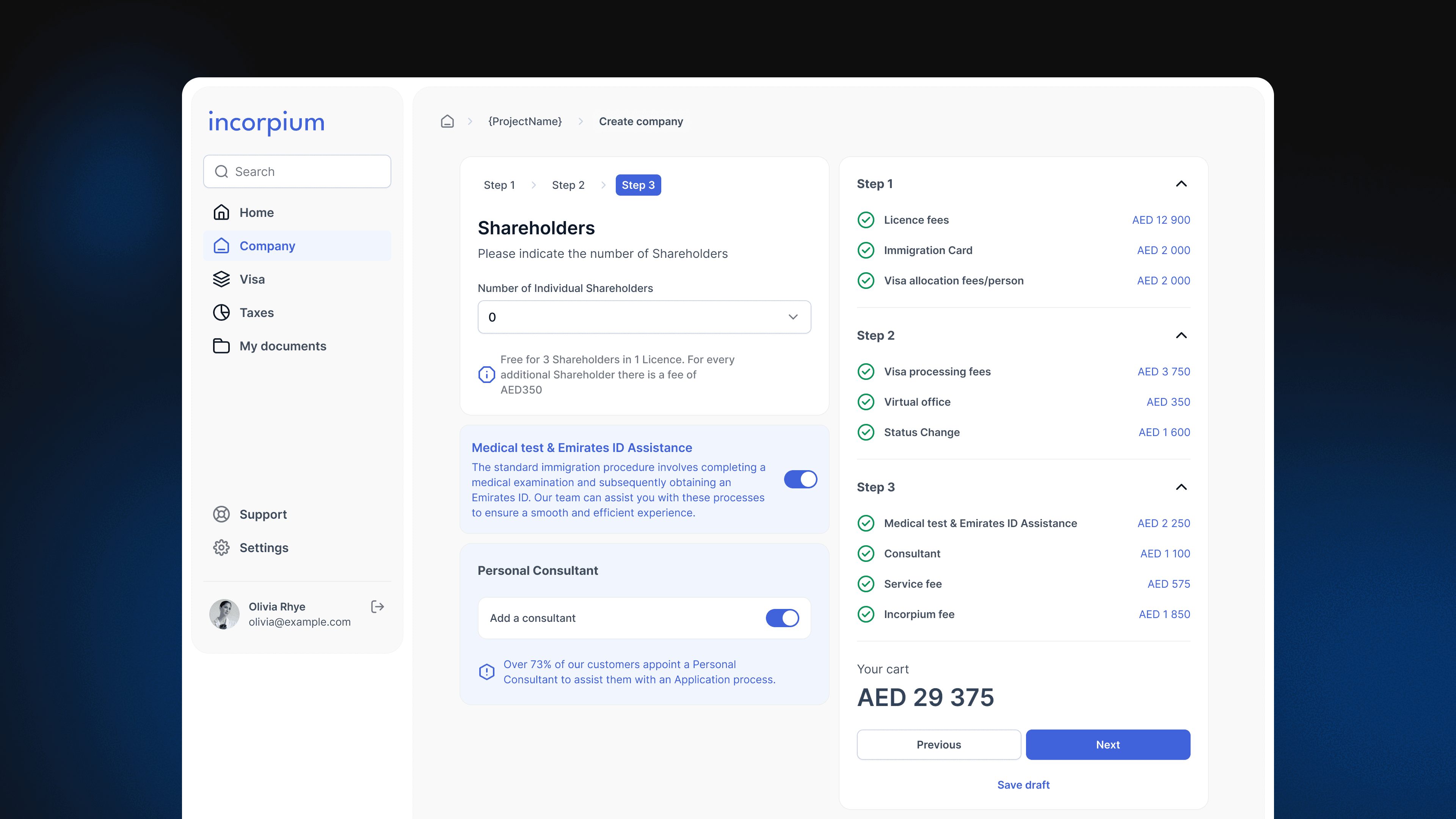
Transparency as the trust weapon. A live, itemized cart mirroring the step structure — directly countering the hidden-margin model of incumbents (e.g. "Free for 3 shareholders, +AED350 each additional," shown at the input).
Lifecycle & recovery design. Persistent progress and a return-to-step state (0/3 → Completed → Approved → Pending payment) so a paused application stays recoverable, like a saved cart.
Branching hidden in controls, not pages. Variable choices (license years, visa count) became steppers; optional services became toggles — each updating a live price. The domain branches, but the experience stays linear.


Iteration
The first version was a single overwhelming mega-form. It buried both users and the team, so I chunked it into 3 digestible steps with a running quote.
Outcome & learning
The flow launched and drove real starts, but conversion stalled at checkout. The blocker wasn't form friction — it was upstream: users often arrived without the data to finish, and paused at the price to comparison-shop before returning. I responded across the journey, not just the UI: progress persistence + abandoned-state recovery, and pre-flow education (webinars, short videos) to make users "application-ready." Sales in my window were modest; the real takeaway — in a high-value B2B financial purchase, the conversion lever lives as much in pre-flow readiness and trust at the money moment as in the form itself.

What I'd do next
A pre-flow document checklist, price/scope surfaced earlier to pre-empt sticker shock, and explicit trust signals (accreditation, "what happens next") at checkout.
